
Whenever we’re about to start a new set of classes, I often receive questions about what kind of dog training equipment people should use. My response is, I know, sometimes frustrating: “It depends.”
Over the next little while, I’ll share some posts about the different types of training tools for dogs, but for now I’d like to start with a few general points that are important to consider when choosing the right equipment.
Every dog is an individual, and so is every handler. When making a decision about what equipment is “best,” it is important to look at both ends of the leash. You may have to go through a bit of trial and error to find what works best for you and your dog.

Here are some important things to keep in mind:
1. Most tools do not teach your dog anything
Most pieces of equipment are primarily for safety and management.
If you want your dog to come when called or stop pulling on the leash, you still need to put in the training. Equipment can help keep your dog safe while you work on building those skills.
2. Some equipment works through discomfort
Equipment that does teach usually does so through some level of discomfort. Some tools used for management can also create discomfort.
There are different levels of discomfort, and discomfort does not necessarily mean pain or fear. However, it’s important to be honest that some level of pressure or discomfort may be involved.
We also need to recognize that some equipment may not be as benign as it appears. If a tool is effective, it’s worth asking yourself: why?
3. Some equipment carries a risk of injury
Certain training tools can put dogs at risk of real injury. This risk needs to be balanced with the risks associated with not using the equipment when there is no effective alternative.
The risk may apply to the handler, the dog, other people, or other animals.
For example, imagine a large, strong dog that pulls its handler to the ground and escapes to chase a deer that disappears into the forest. The handler could be seriously injured, the dog could harm the deer, and the dog could become lost and never be found again.
4. No single piece of equipment works for every dog
There is no universal solution when it comes to dog training equipment.
Dogs are individuals, and like us, each dog has a different tolerance for pressure or discomfort. Slight pressure may be enough to discourage some dogs from pulling, while the same pressure has no effect on others.
For example, I once had a Sheltie that stopped pulling the moment she felt any pressure on her collar. My current dog couldn’t care less how much pressure he feels from a collar.
Also, equipment that works well for a trained dog may be very different from the equipment needed to manage a dog while training is still in progress.
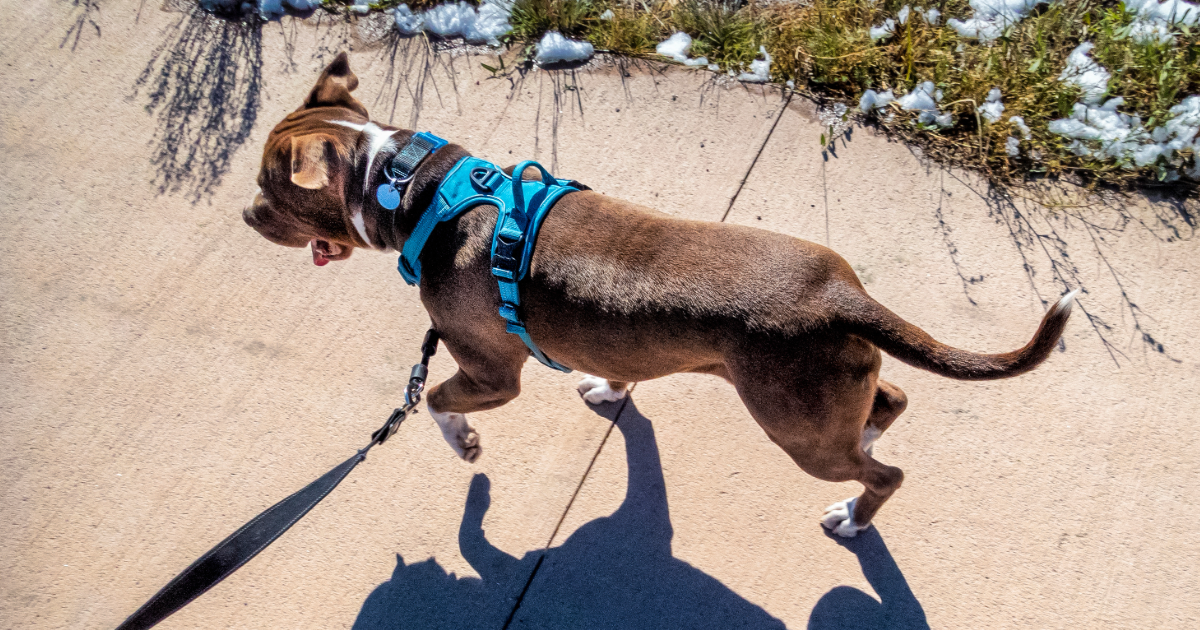
For instance, I use a back-clip harness on puppies that haven’t yet learned to walk politely on a leash. The puppy can safely pull to its heart’s content while I’m training it. Once the puppy has learned to walk nicely on a flat collar, I stop using the harness.
Handlers with reactive dogs may also require different equipment than handlers with neutral dogs. A reactive dog may need equipment that allows the handler to redirect the dog’s head or body. A neutral dog may not require this level of control.
5. The right equipment depends on both ends of the leash
The ideal choice of equipment depends on both the dog and the handler.
For example, I might recommend one type of equipment for a 5’2” handler in her 80s who has a bouncy adolescent Golden Retriever. I might recommend something very different for that same handler if she had a Chihuahua.
Similarly, the recommendation might change again if that same energetic Retriever had a strong 6’3” handler in his mid-30s.
6. Every tool has pros and cons
Every piece of dog training equipment has advantages and disadvantages.
Some tools are very gentle for the dog but offer the handler little control. Others give the handler more control but may be less comfortable for the dog. Some options are also more expensive than others.
7. Training equipment can be controversial
Training tools are one of the most controversial topics in dog training.
Almost every piece of equipment has trainers who love it and others who strongly dislike it. There is a lot of conflicting information out there, and it can sometimes be difficult for dog owners to sort through it all.
Finding the right balance
Choosing the right dog training equipment is often a balancing act.
You need to consider:
• your dog’s size, behaviour, and temperament
• your own abilities and comfort level
• your training goals
• potential safety risks
A good place to start is with the option that feels most suitable to you. If it isn’t giving you the results you hoped for (keeping in mind Point 1 above), it may be worth trying a different type of equipment.
Sometimes it takes experimenting with several options — or even combinations — before you find what works best for both you and your dog.
And remember: no piece of equipment can replace proper training.
But training your dog is the fun part. 😊
Stay tuned for upcoming posts where we’ll look at specific types of dog training equipment and how they can be used.

Looking for Dog Training in Ladysmith, British Columbia, or Nearby?
We Can Help! At Canine Companions, we offer Group Dog Training Classes that provide a fun and supportive environment for your dog to learn essential skills while socializing with other dogs and people. These classes are ideal for building your dog’s confidence and improving obedience in a real-world setting. Learn more about our classes here!
If you’re dealing with specific challenges, our Private Dog Training Sessions are a fantastic option. These one-on-one lessons allow us to create a customized training plan tailored to your goals and your dog’s unique needs. Whether it’s addressing problem behaviors or mastering advanced skills, private sessions offer focused attention and faster progress.
And don’t forget to follow us on Instagram and Facebook for dog training tips, fun videos, and expert advice to help you and your dog thrive!